



How to Choose a Radon Mitigation Company

Wisconsin has no state licensing requirement for radon mitigation work. Any contractor, remodeler, or handyman can legally install a system with zero training, zero credentials, and zero oversight. That matters here more than almost anywhere else in the country, because Wisconsin's mean indoor radon level is 5.7 pCi/L, more than four times the national average of 1.3 pCi/L, according to the Wisconsin Department of Health Services. One in ten Wisconsin homes has elevated radon levels. In 46% of Wisconsin zip codes, at least half of all test results exceed the 4.0 pCi/L EPA action level.
The burden of finding a qualified radon mitigation company falls entirely on you. Most first-time mitigation buyers go in blind. They do not know what credentials to verify, what red flags to watch for, or what questions separate a qualified contractor from an unqualified one. A wrong choice does not just waste money. It leaves you with a system that may not reduce radon, creates potential combustion safety hazards, and provides no documentation for resale.
This guide gives you a clear framework to evaluate any radon mitigation company, whether you are dealing with a high radon test result, buying a home, or comparing quotes. We cover the specific certifications to check, the installation standards to expect, the warranty terms to scrutinize, the questions to ask during site visits, and the pricing reality in South Central Wisconsin.
Why NRPP Certification Is the First Thing to Check
Most homeowners start their search by reading Google reviews or asking for referrals. Those are useful, but they do not confirm whether a contractor is actually qualified. NRPP certification is the single most reliable credential in the radon industry, and it is the first thing you should verify before calling anyone.
What NRPP Certification Means
NRPP (National Radon Proficiency Program) is accredited by the ANSI National Accreditation Board (ANAB) under ANSI/ISO/IEC 17024, the international standard for personnel certification bodies. Two designations matter for residential radon work:
RMS (Radon Mitigation Specialist): Covers radon mitigation system design, installation, quality management, and worker safety. This is the credential you want for the person installing your system.
RMP (Radon Measurement Professional): Covers radon testing using professional-grade analytical or passive devices with full QA/QC oversight.
Both designations require passing accredited exams, demonstrating field competency, adhering to the NRPP Code of Ethics, and completing 12 hours of continuing education per credential every two years to maintain active status. A contractor holding both RMS and RMP certifications demonstrates full-spectrum competency in radon testing and remediation.
The second major certification body that follows ANSI guidelines is the NRSB. They have similar training and certification requirements, and is also recognized by the EPA.
How to Verify It Yourself
Do not take a contractor's word for their certification status. Verify it in under two minutes:
Go to nrpp.info/pro-search/ or https://nrsb.org/for-professional/
Enter the contractor's name or certification number
Confirm the certification type includes RMS (for mitigation work)
Confirm the status shows "Active" with a future expiration date
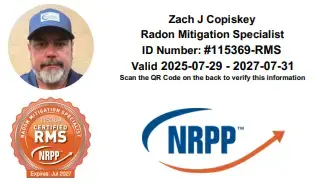
You can also ask for the professionals credentials in person - they should have certification identification cards they can share with you similar to these from our co-founder Zach.

Why This Matters in Wisconsin Specifically
According to the Wisconsin Department of Health Services, approximately 150 NRPP or NRSB certified radon contractors operate in the entire state. The rest of the radon work comes from uncertified contractors operating legally but without accountability and no standardized installation guidelines. Wisconsin's lack of state licensing creates a race-to-the-bottom dynamic where any contractor can claim radon expertise with no verification mechanism.
"Wisconsin's lack of state licensing creates a 'race to the bottom.' The approximately 150 certified contractors represent only a small fraction of those who do radon work statewide." - NRPP-certified radon professionals, on Wisconsin's unregulated market
If a certified contractor does substandard work, you can file a complaint through NRPP here. No such mechanism exists for uncertified contractors. Before you call a single contractor, go to nrpp.info/pro-search/ and search your zip code. That is your shortlist.
Red Flags That Should Make You Walk Away
A qualified radon mitigation company welcomes scrutiny. An unqualified one avoids it. These red flags indicate a contractor who is either unqualified, dishonest, or cutting corners that directly affect whether your system will actually reduce radon levels.
Credential Red Flags
Cannot provide an NRPP or NRSB certification number when asked
Says they have a certification from some other body that isn't recognized by national and state health agencies
Claims "years of experience" as a substitute for certification
Certification is expired or suspended (verify online, do not trust a verbal claim) or says they are certified with an unrecognized certification body.
Lists only a general contractor license as qualification for radon work
Process Red Flags
Provides an estimate by phone without visiting your property. May be outsourcing the work to other contractors.
No post-mitigation confirmation test included. A system without a verification test is an unproven system.
Full payment demanded before installation or before post-mitigation test results are available
Proposal Red Flags
A quote significantly lower than all competitors. This is often a setup for change-order charges mid-installation, where unexpected "extras" appear after work has already started. These may also be marketing companies that hire outside workers like handymen locally (again, not specializing in proper radon mitigation or testing techniques) to perform the work for them.
No written proposal, or a vague scope of work that does not specify materials, steps, or standards
A "lifetime warranty" with exclusions so broad it effectively covers nothing
No warranty at all
High-pressure sales tactics or urgency to sign before you have time to compare
Conflict of Interest
You may consider using a separate radon testing company for the initial or post mitigation test. There can be a conflict of interest where some unethical companies would provide elevated readings up front to make you believe you need the mitigation system. Independent radon testing removes this conflict and gives you unbiased data. This is another reason too consider certified NRPP or NRSB professionals as they commit to never altering data during testing. As mentioned earlier, each certification body also provides the ability to file a complaint against certified individuals that do not follow proper procedures of testing or installation.
If you do use the same company for both, require that a post-mitigation confirmation test is included. Qualified radon mitigation contractors welcome your scrutiny and if asked can provide detailed records of their testing device lab calibrations (required annually for all continuous radon monitors under NRPP or NRSB standards) and hourly reports for all tests. If a contractor fails any one of these checks, move to the next name on your list.
10 Questions to Ask Before Hiring a Radon Mitigation Company
You do not need to be a radon expert to evaluate a contractor. You just need the right questions. Print this list and use it during phone calls or site visits. A qualified radon mitigation company will answer every one confidently.
Certification and Insurance (Questions 1-2)
"Are you NRPP or NRSB certified? What is your certification number?" Get the number. Verify it yourself at nrpp.info/verify-certification/. These two questions alone filter out the majority of unqualified contractors in Wisconsin.
"Do you carry liability insurance and workers' compensation?" Ask for a certificate of insurance. If someone is injured on your property during installation and the contractor lacks coverage, you carry the liability.
Technical Process (Questions 3-6)
"Will you perform PFE diagnostic testing during the installation process?" PFE testing measures how far suction extends under the slab from a candidate drill point. It determines optimal suction point placement and fan sizing. This step is not always necessary but the technician should be able to perform the necessary diagnostics whenever it's needed.
"Do you perform combustion safety screening before AND after installation?" Active sub-slab depressurization systems create negative pressure that can cause gas appliances to backdraft carbon monoxide into living spaces. ANSI/AARST SGM-SF standards require this on every installation.
"What ANSI/AARST standards does your installation follow?" The answer you want is SGM-SF (Soil Gas Mitigation Standard for Single Family homes). This is the nationally recognized installation standard with specific requirements for materials, pipe routing, sealing, exhaust placement, and post-installation verification.
"Do you include a post-mitigation radon test, and when is payment due?" The best contractors include a 48-hour confirmation test and tie final payment to verified results. If payment is due before the post-mitigation test, you have no leverage to ensure the system works.
Business Practices (Questions 7-10)
"What exactly does your warranty cover, and does it transfer to future homeowners?" A quality contractor provides a written warranty document before you sign. Vague answers are a red flag. Default fan warranties for major providers is 5 years alone. If the contractor warranty varies from this inquire further as to why.
"Will you pull permits if required by my local jurisdiction?" Check your jurisdiction. For now Wisconsin broadly has no mitigation regulations. Since the state has loose regulations, most municipalities do not currently require any permitting (as of 2026) for mitigation.
"Can you provide before-and-after radon test results from past installations?" Documented results prove competency. We share ours openly: 17.8 to 1.5 pCi/L in Baraboo (91.6% reduction) and 7.3 to 0.3 pCi/L in the town of Dane (95.9% reduction). And many more.
"Is your written proposal itemized, and will the final contract match it?" An itemized proposal lets you compare quotes line by line. If the contract differs from the proposal, stop and ask why.
What a Proper Radon Mitigation Installation Actually Includes
Most homeowners have never seen a radon mitigation system installed. That makes it difficult to distinguish a standards-compliant installation from a shortcut job. A proper installation follows the ANSI/AARST SGM-SF standard, which establishes minimum requirements for radon mitigation in single-family homes.
Installation Standards
A compliant installation includes specific materials and practices:
Schedule 40 PVC pipe (not thin-wall PVC)
Minimum 1/8" per foot slope on all pipe runs toward the suction point for condensate drainage
All cracks and gaps of significance sealed with ASTM C920 class 25+ caulk
Sump covers sealed while maintaining existing drainage function
Firestop collars installed where pipes route through garages
Exhaust discharge terminating at least 6 inches above the roofline, 10 feet above ground, and 10 feet from any window, door, or air intake
A visual monitoring gauge (manometer) installed on the pipe so you can see the system is operating
Most installations take 4 to 8 hours in a single visit.
Post-Installation Verification
Once the contractor activates the system, a proper installation includes:
Combustion safety re-test: Confirms the ASD system did not create new backdrafting conditions. A documented case in Kent, Ohio showed that a radon system caused extreme backdrafting in the water heater when a whole-house fan ran simultaneously. This is exactly why post-installation re-testing exists.
48-hour post-mitigation radon test: Confirms radon levels have dropped below the 4.0 pCi/L EPA action level
System documentation packet: Includes test results, warranty documents, fan manual, maintenance instructions, and a record of all installation details
Without these steps, you have no evidence the system works and no documentation for future reference or resale. Learn more about what a complete radon mitigation system includes.
How to Evaluate a Radon Mitigation Warranty
A warranty sounds reassuring until you read the fine print. Not all radon mitigation warranties are equal, and some "lifetime warranties" cover almost nothing once you examine the exclusions.
What a Strong Warranty Covers
A meaningful warranty protects workmanship, not just parts. "Parts only" coverage is nearly worthless because PVC pipe almost never fails on its own. Look for coverage that includes:
Suction points
Floor and wall sealing
All PVC piping and fittings
Exterior supports and penetrations
Flashing and condensate management
System labels and monitoring devices
A minimum five-year term is a reasonable baseline. Anything shorter raises questions about the contractor's confidence in their own work.
Transferability Matters
A warranty that transfers to future homeowners adds real estate value. The best case is automatic transfer with no paperwork required. The worst case is a warranty that dies with the original owner, making the system less valuable at resale. If you plan to sell your home within the warranty period, transferability directly affects your return on the mitigation investment.
Performance Guarantee
Ask whether the company guarantees radon levels below the 4.0 pCi/L EPA action level. According to the EPA, radon is the second leading cause of lung cancer in the United States, responsible for approximately 21,000 deaths annually. A quality contractor will return at no cost if post-mitigation levels remain elevated. This guarantee, combined with an included post-mitigation test and payment tied to verified results, gives you measurable proof that the system performs as promised.
Also ask about repair warranties for non-original installations. A contractor inheriting another company's flawed system cannot warrant work they did not do.
Watch for "Lifetime Warranty" Traps
According to HomeAdvisor, many companies' lifetime warranties have so many exceptions that they offer almost no real coverage. Some only cover PVC pipe and exclude everything else. Ask for the full warranty document before signing. If a contractor cannot or will not provide it, that tells you what you need to know.
What Radon Mitigation Should Cost in Wisconsin
A professionally installed radon mitigation system in Wisconsin typically costs between $1,300 and $2,300. Knowing the pricing range upfront helps you compare quotes intelligently and spot outliers in either direction. Our experience in south-central Wisconsin generally is estimates that come in below $1,300 for a full radon mitigation system are almost always provided by uncertified contractors.
Wisconsin Pricing Context
Multiple sources confirm the typical range:
Wisconsin DHS: $1,000-$2,000 average
City of Milwaukee: $1,500-$2,000 typical
National average (HomeAdvisor): $786-$1,274
Wisconsin and south-central Wisconsin area runs higher than the national average because regional foundation types, soil conditions, inflationary pressures (higher cost of living in more populated south-central WI areas), and longer heating seasons require more robust system designs. Our pricing at PureTech Home Services falls within the $1,300-$2,300 range depending on home complexity. We also apply a $150 test credit toward mitigation for customers who have already paid for a radon test, reducing the effective cost.
What the Price Covers
A complete quote includes:
Diagnostic testing (PFE)
All materials (Schedule 40 PVC, fan, sealants)
Labor and installation
Sealing of all cracks and penetrations
Permits (if required by your jurisdiction)
Post-mitigation confirmation test
System documentation
Warranty
If any of these items are missing from a quote, the "lower price" is not actually lower. You will either pay for those items as change orders during installation or go without them entirely, leaving your system unverified and undocumented.
How to Compare Quotes Fairly
Consider getting multiple quotes. Require a site visit for each one, and reject any phone-only estimate. Compare proposals line by line, including payment timing: is final payment due before or after the post-mitigation test? A $150 difference between two complete proposals is normal variation. A $500 difference usually means the cheaper quote is omitting work the other contractor included.
Additional costs to factor in: active radon fans draw 100-300 watts continuously, adding approximately $30-$300 per year to your electricity bill. Lost HVAC air exchange can also cost an additional $200-$700.
Look at previous body of work (ie: examples and evidence of jobs they've completed and successfully mitigated). Do they have Google reviews / testimonials? Consider looking over their reviews to see if they look legitimate and have satisfied customers. The real question is not which radon mitigation company is cheapest. It is which one includes everything you need to verify the system actually works.
Radon Mitigation During a Real Estate Transaction
Real estate timelines push fast decisions. Buyers and sellers both face pressure to resolve radon issues quickly, and that pressure can lead to hiring the first available contractor without verifying qualifications. Wisconsin's legal framework makes it critical to understand what the law requires, what experts recommend, and what is negotiable.
Wisconsin Law Specifics
According to Wisconsin DHS, sellers must disclose known unsafe radon levels in the residential real estate Condition Report. However, two things the law does not require:
Radon testing. Wisconsin DHS strongly recommends it, but cannot mandate it.
Mitigation by sellers, even if the home tests above the 4.0 pCi/L EPA action level.
This creates a negotiation dynamic, not a legal mandate. Both parties benefit from understanding where the leverage sits.
If You Are Buying
Approximately 66% of Wisconsin counties fall into EPA Zone 1, where average indoor radon levels are expected to exceed 4.0 pCi/L. Consider choosing an independent certified radon testing performed by a professional you choose, not one connected to the seller's agent. Though it's not likely to be an issue, this removes any opportunity for an unethical arrangement between contractor and agent. Use a minimum 48-hour closed-condition test with windows and doors closed for at least 12 hours before the test begins.
If levels come back at or above 4.0 pCi/L, negotiate mitigation or a mitigation credit into the purchase agreement. Verify that any existing system was installed by an NRPP or NRSB certified contractor.
If You Are Selling
A professionally installed, certified, and warrantied radon mitigation system with an auto-transferring warranty is a selling point. In 46% of Wisconsin zip codes, at least half of all test results exceed the EPA action level. Buyers are increasingly radon-aware. Proactive mitigation removes a negotiation obstacle and demonstrates transparency.
"Reducing radon from elevated levels does not just halve the risk. The relationship between radon exposure and lung cancer is cumulative. Getting below 2.0 pCi/L essentially eliminates the excess risk from radon exposure." - U.S. EPA guidance on radon health risks
Time Pressure Caution
Do not accept a radon mitigation company just because they can start tomorrow. Certification and quality still matter, especially when the system becomes the new owner's responsibility for years to come. Whether you are buying or selling, a certified radon mitigation contractor protects both sides of the transaction.
Frequently Asked Questions About Choosing a Radon Mitigation Company
Does Wisconsin require radon contractors to be licensed?
No. Wisconsin has no state licensing requirement for radon mitigation work. Any contractor can legally install a radon system without training or credentials. NRPP or NRSB certification is the only verifiable credential. The Wisconsin DHS recommends using nationally certified contractors. Only about 150 certified radon professionals operate statewide.
How much does radon mitigation cost in Wisconsin?
A professionally installed ASD system in Wisconsin typically costs $1,000-$2,300, according to the Wisconsin Department of Health Services. Get at least three itemized quotes and compare line by line. A quote significantly lower than others usually omits diagnostic testing, post-mitigation verification, or permits.
How can I verify a contractor's NRPP certification?
Visit nrpp.info/pro-search/ or https://nrsb.org/for-professional/. Enter the contractor's name or certification number. Confirm "Active" status with a future expiration date. Both are EPA-recognized certification programs.
Should the same company test and mitigate my radon?
Ideally, no. The company performing the fix has a financial incentive for a high test result. If you do use one company for both, ensure a post-mitigation test is included and payment is tied to verified results. Most certified contractors follow standards and will not alter results for financial incentive, but independent testing does remove the conflict of interest from the equation completely.
What is a good radon level after mitigation?
Any system should bring levels below the 4.0 pCi/L EPA action level. Results below 2.0 pCi/L are excellent and even typical for properly designed systems. Quality contractors guarantee below 4.0 pCi/L or return at no cost to adjust. Our results include many examples of below 1.0 pCi/L readings post-mitigation.
What is combustion safety testing?
ASD systems create negative pressure that can cause gas appliances to backdraft carbon monoxide into your home. ANSI/AARST SGM-SF standards require combustion safety screening under worst-case conditions on every installation. Ask whether your contractor performs this before and after system activation.
How long does radon mitigation take?
A typical ASD installation takes 4 to 8 hours in a single visit. ASD systems reduce radon levels by 50-99%. The post-mitigation confirmation test adds 72 hours (24 hr delay + 48 hr test) before final results are available. Most projects wrap up within one week.
My home has a passive radon system from the builder. Is that enough?
Often not. Passive systems rely on stack effect rather than active fan suction and frequently fail to maintain adequate depressurization. Test your home regardless. If levels exceed 2.0 pCi/L, consider having a certified contractor add a fan to convert it to an active system. Active systems are far more reliable at maintaining safe radon levels.
Ready to work with an NRPP-certified specialist in South Central Wisconsin? Learn about our radon mitigation systems and request a consultation.
